Atlas 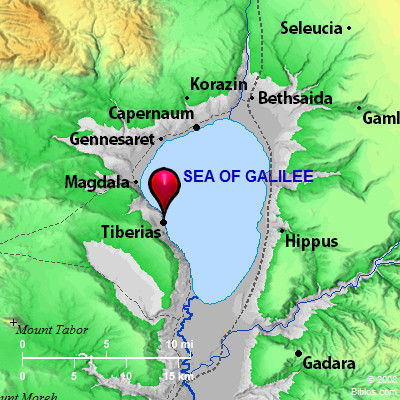 Tiberias and surrounding area Maps Created using Biblemapper 3.0 Additional data from OpenBible.info Occurrences John 6:23 However boats from Tiberias came near to the place where they ate the bread after the Lord had given thanks.Encyclopedia TIBERIASti-be'-ri-as ([Tiberias], John 6:23): About the middle of the western shore of the Sea of Galilee, the mountains fall back from the coast, and leave a roughly crescent-shaped plain, about 2 miles in length. The modern city of Tiberias (Tabariyeh) stands at the northern extremity, where the ground begins to rise; and the Hot Baths (Hammath) at the south end. On the southern part of this plain Herod Antipas built a city (circa 26 A.D.), calling it "Tiberias" in honor of the emperor who had befriended him. In clearing the ground and digging foundations certain tombs were disturbed (Ant., XVIII ii, 3). It may have been the graveyard of old Hammath. The palace, the famous "Golden House," was built on the top of a rocky hill which rises on the West to a height of some 500 ft. The ruin is known today as Qasr bint el-Melek, "Palace of the King's Daughter" The strong walls of the city can be traced in almost their entire length on the landward side. Parts are also to be seen along the shore, with towers at intervals which guarded against attack by sea. The ruins cover a considerable area. There is nothing above ground older than Herod's city. Only excavation can show whether or not the Talmud is fight in saying that Tiberias was built on the site of Rakkath and Chinnereth (Neubauer, Geog. du Talmud, 208). The Jews were shy of settling in a city built over an old cemetery; and Herod had trouble in finding occupants for it. A strange company it was that he ultimately gathered of the "poorer people," foreigners, and others "not quite freemen"; and these were drawn by the prospect of good houses and land which he freely promised them. With its stadium, its palace "with figures of living things" and its senate, it may be properly described as a Greek city, although it also contained a proseuche, or place of prayer, for the Jews (BJ II, xxi, 6; Vita, XII, 54, etc.). This accounts for it figuring so little in the Gospels. In his anxiety to win the favor of the Jews, Herod built for them "the finest synagogue in Galilee"; but many years were to elapse before it should become a really Jewish city. TIBERIAS, a city of about 4000 pop. on the w. shore of the sea of Galilee, and 4 1/2 ms. from its s. end. It was built between Asher Dan 16 and 22, by Herod, in honor of Tiberius, and was a new city in the time of our Savior and is mentioned only once, John 6:23. Sea of Tiberias and sea of Galilee, are the same. Strong's Greek G5085: TiberiasTiberias, a city of Galilee, also another name for the Sea of Galilee |
    |