Atlas 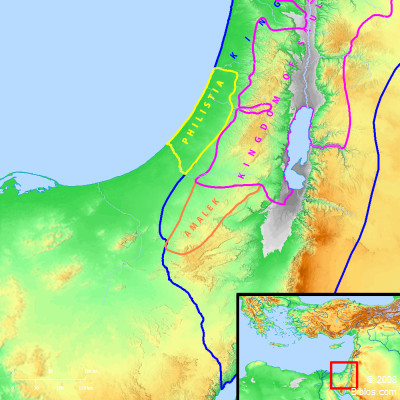 Philistia and surrounding region Maps Created using Biblemapper 3.0 Additional data from OpenBible.info Occurrences Exodus 15:14 The peoples have heard. They tremble. Pangs have taken hold on the inhabitants of Philistia.Isaiah 14:29 Don't rejoice, O Philistia, all of you, because the rod that struck you is broken; for out of the serpent's root an adder will emerge, and his fruit will be a fiery flying serpent. Isaiah 14:31 Howl, gate! Cry, city! You are melted away, Philistia, all of you; for smoke comes out of the north, and there is no straggler in his ranks. Joel 3:4 "Yes, and what are you to me, Tyre, and Sidon, and all the regions of Philistia? Will you repay me? And if you repay me, I will swiftly and speedily return your repayment on your own head. Zechariah 9:6 Foreigners will dwell in Ashdod, and I will cut off the pride of the Philistines. Encyclopedia PHILISTIAfi-lis'-ti-a: The country is referred to under various designations in the Old Testament: namely, pelesheth (Philistia) (Psalm 60:8 (Hebrew 10); 87:4), 'erets pelishtim, "land of the Philistines" (Genesis 21:32, 34), geloth hapelishtim; Septuagint ge ton Phulistieim, "the regions of the Philistines" (Joshua 13:2). The Egyptian monuments have Puirsatha, Pulsath (Budge), Peleset (Breasted) and Purasati (HGHL), according to the different voweling of the radicals; the Assyrian form is Palastu or Pilistu, which corresponds very closely to the Egyptian and the Hebrew. The extent of the land is indicated in Joshua 13:2 as being from the Shihor, or Brook of Egypt (Revised Version), to the border of Ekron, northward. The eastern border was along the Judean foothills on the line of Beth-shemesh (1 Samuel 6:9) with the sea on the West. It was a very small country, from 25 to 30 miles in length and with an average width of about half the length, but it was fertile, being an extension of the plain of Sharon, except that along the coast high sand dunes encroached upon the cultivated tract. It contained many towns and villages, the most important being the five so often mentioned in Scripture: Gaza, Ashdod, Ashkelon, Gath and Ekron. The population must have been large for the territory, which enabled them to contend successfully with the Israelites, notwithstanding the superiority of position in the hills to the advantage of the latter. PALESTINE, at first this word was applied only to the country of the Philistines, but in the time to Josephus and by some Greek and Roman writers it became to be applied to all the land of the Jews. The utmost extent, in area, of Palestine, as actually occupied by ancient Israelites, did not exceed 8400 square' miles. From Dan to Beersheba was not only the usual expression for the extent of country, but it was the actual habitable area and, w. of Jordan, it was 140 ms. n. and s. with an average of 40 ms. e. and w., equal to 5600 square ms. Adding an easterly extent of 20 ms. with the same n. and s. distance, on the e. of the Jordan, the area would be increased by 2800, total 8400, and this is the utmost. The 12 to 13,000 sq. ms. given to Palestine by various authors are not sustained by either the English exploration survey, or by Biblical history. While the power of Solomon was extended at one time probably to the Euphrates, the desert was not inhabited. The name Palestina occurs but three times, Exod. 15:14, Is. 14:29, 31, but in Joel 3:4 it is Palestinein all cases alluding to the region of the Philistines only 1 Sam. 13:19 gives the name used by the Israelites for the country, namely, Land of Israel. In the middle ages it became known as "The Holy Land." For the name Canaan, see Canaan. In Zech. 2:12, it is called "the holy land." PHILISTIA, the land of the Philistines s.w. of Palestine, see map No. 3. Strong's Hebrew H6429: Peleshetha territory on the S. Mediterranean coast of Isr. |
    |