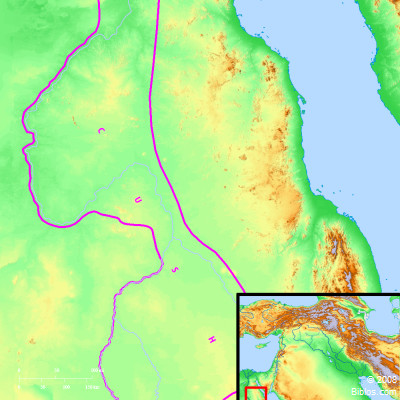
Cush


Cush and surrounding region

Maps Created using Biblemapper 3.0

Additional data from OpenBible.info

Genesis 2:13 The name of the second river is Gihon: the same river that flows through the whole land of Cush.

2 Kings 19:9 When he heard it said of Tirhakah king of Ethiopia, "Behold, he has come out to fight against you, he sent messengers again to Hezekiah, saying,

Isaiah 11:11 It will happen in that day that the Lord will set his hand again the second time to recover the remnant that is left of his people from Assyria, from Egypt, from Pathros, from Cush, from Elam, from Shinar, from Hamath, and from the islands of the sea.

Isaiah 18:1 Ah, the land of the rustling of wings, which is beyond the rivers of Ethiopia;

Isaiah 20:3 Yahweh said, "As my servant Isaiah has walked naked and barefoot three years for a sign and a wonder concerning Egypt and concerning Ethiopia,

Isaiah 20:5 They will be dismayed and confounded, because of Ethiopia their expectation, and of Egypt their glory.

Isaiah 37:9 He heard news concerning Tirhakah king of Ethiopia, "He has come out to fight against you." When he heard it, he sent messengers to Hezekiah, saying,

Isaiah 43:3 For I am Yahweh your God, the Holy One of Israel, your Savior. I have given Egypt as your ransom, Ethiopia and Seba in your place.

Isaiah 45:14 Thus says Yahweh: "The labor of Egypt, and the merchandise of Ethiopia, and the Sabeans, men of stature, shall come over to you, and they shall be yours. They will go after you. They shall come over in chains; and they will bow down to you. They will make supplication to you:'Surely God is in you; and there is none else. There is no other god.

Jeremiah 46:9 Go up, you horses; and rage, you chariots; and let the mighty men go forth: Cush and Put, who handle the shield; and the Ludim, who handle and bend the bow.

Ezekiel 29:10 therefore, behold, I am against you, and against your rivers, and I will make the land of Egypt an utter waste and desolation, from the tower of Seveneh even to the border of Ethiopia.

Ezekiel 30:4 A sword shall come on Egypt, and anguish shall be in Ethiopia, when the slain shall fall in Egypt; and they shall take away her multitude, and her foundations shall be broken down.

Ezekiel 30:5 Ethiopia, and Put, and Lud, and all the mixed people, and Cub, and the children of the land that is in league, shall fall with them by the sword.

Ezekiel 30:9 In that day shall messengers go forth from before me in ships to make the careless Ethiopians afraid; and there shall be anguish on them, as in the day of Egypt; for, behold, it comes.

Ezekiel 38:5 Persia, Cush, and Put with them, all of them with shield and helmet;

Nahum 3:9 Cush and Egypt were her boundless strength. Put and Libya were her helpers.

Zephaniah 3:10 From beyond the rivers of Cush, my worshipers, even the daughter of my dispersed people, will bring my offering.


You are free to use up to 50 maps (small or large) for your website or presentation. Please credit Biblos.com. You may not redistribute or resell these materials. For additional permissions, contact us via the Biblos homepage.
CUSH (1)

kush (kush):

1. The Ancestor of Many Nations:

(1) The first of the sons of Ham, from whom sprang Seba, Havilah, Sabtah, Raamah and Sabtecah. He was also the father of Nimrod, who rounded Babel (Babylon) and the other great states of Shinar or Babylonia (Genesis 10:6-8). The meaning of the name is uncertain.

(2) The name of the country around which the Gihon flowed (Genesis 2:13), rendered "Ethiopia" in the King James Version, but in view of the distance of that country from the other rivers mentioned, this seems to be an unlikely identification.

2. A District of the Garden of Eden:

Fried. Delitzsch has suggested (Wo lag das Paradies? 74) that the watercourse in question is the canal Gu-hande or Arahtu, which, coming from the South, entered Babylon a little to the East of the Euphrates, and, flowing alongside the Festival-Street, entered the Euphrates to the North of Nebuchadrezzar's palace. Koldewey (Tempel von Babylon und Borsippa, 38) regards the Gu-hande as the section of the Euphrates itself at this point. There is no indication, however, that the district which it enclosed was ever called Kusu or Cush, and the suppression of the final syllable of Gu-hande would remain unexplained. Moreover, the identification of Cush with a possible Cas, for Kasdu, "Chaldea," seems likewise improbable, especially as that name could only have been applied, in early times, to the district bordering on the Persian Gulf (see CHALDEA).

3. Probably not in Asia Minor:

Another theory is, that the Cush of Genesis 2:13 is the Kusu of certain Assyrian letters, where it seems to designate a district in the neighborhood of Cappadocia. This identification apparently leads us back to an ancient tradition at one time current in the East, but later forgotten, which caused the Pyramus river to assume the name of Jihun (i.e. Gihon). This stream rises in the mountains Northeast of the Gulf of Alexandretta, and, taking a southwesterly course, flows into the Mediterranean near Karatash. Though nearer than the Ethiopian Cush, this is still too far West, and therefore unsatisfactory as an identification-all the streams or waterways of the Garden of Eden ought to flow through the same district.

4. The Ethiopian Cush:

(3) The well-known country of Cush or Ethiopia, from Syene (Ezekiel 29:10) southward-Egyptian Kos, Babylonian Kusu, Assyrian Kusu. This name sometimes denotes the land (Isaiah 11:11; Isaiah 18:1 Zephaniah 3:10 Ezekiel 29:10 Job 28:19 Esther 1:1; Esther 8:9); sometimes the peopl (Isaiah 20:4 Jeremiah 46:9 Ezekiel 38:5); but is in many passages uncertain. Notwithstanding that the descendants of Ham are always regarded as non-Semites, the Ethiopians, Ge`ez, as they called themselves, spoke a Semitic language of special interest on account of its likeness to Himyaritic, and its illustration of certain forms in Assyro-Babylonian. These Cushites were in all probability migrants from another (more northerly) district, and akin to the Canaanites-like them, dark, but by no means black, and certainly not Negroes. W. Max Muller (Asien und Europa, 113 note) states that it cannot be proved whether the Egyptians had quite black neighbors (on the South). In earlier times they are represented as brown, and later as brown mingled with black, implying that negroes only came to their knowledge as a distinct and extensive race in comparatively late times. Moses' (first?) wife (Numbers 12:1) was certainly therefore not a Negress, but simply a Cushite woman, probably speaking a Semitic language-prehistoric Ge`ez or Ethiopian (see CUSHITE WOMAN). In all probability Semitic tribes were classed as Hamitic simply because they acknowledged the supremacy of the Hamitic Egyptians, just as the non-Sem Elamites were set down as Semites (Genesis 10:22) on account of their acknowledging Babylonian supremacy. It is doubtful whether the Hebrews, in ancient times, knew of the Negro race-they probably became acquainted with them long after the Egyptians.

5. Negroes Probably not Included:

In the opinion of W. Max Mailer (A, und East, 112), the Egyptians, when they became acquainted with the Negroes, having no word to express this race, classed them with the nechese, which thereafter included the Negroes. If the Hebrew name Phinehas (Pi-nechas) be really Egyptian and mean "the black," there is still no need to suppose that this meant "the Negro," for no Israelite would have borne a name with such a signification. The treasurer of Candace queen of Meroe (Acts 8:27-39)-the Ethiopian eunuch-was an Abyssinian, not a Negro; and being an educated man, was able to read the Hebrew Scriptures in the Greek (Septuagint) version. Cush (mat Kusi, pr. Kushi) is frequently mentioned in the Assyrian inscriptions in company with Melubha (Merohha) to indicate Ethiopia and Meroe.

See EDEN; ETHIOPIA; TABLE OF NATIONS.

T. G. Pinches


International Standard Bible Encyclopedia

Bible Atlas Home